
Precision engineering is the controlled manufacture of components to defined technical requirements, with a focus on accuracy, repeatability and consistent quality.
For manufacturers, however, producing an accurate component is only part of the requirement. That component may also need to be inspected, documented, finished, assembled and supplied in line with a production schedule.
This is why precision engineering in manufacturing is about more than achieving the right measurement once. It depends on having the processes and controls needed to reproduce the required result consistently.
For engineering, procurement and production teams, that consistency helps reduce uncertainty throughout the wider manufacturing process.
What Does Precision Engineering Involve?
Precision engineering can involve CNC milling and turning together with inspection, finishing, coatings, inserts, assembly, packaging and other secondary operations.
The exact requirement depends on the component and its application. Some parts may need relatively straightforward dimensional checks, while others require greater levels of process control, traceability and documentation.
The important point is repeatability.
A supplier needs to understand the drawing, choose an appropriate manufacturing approach, control the process and verify that the finished component meets the specified requirements.
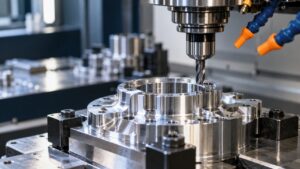
Why Does Precision Matter in Manufacturing?
Variation in a component can create problems elsewhere in production.
Differences in dimensions can affect fit or alignment within an assembly, while inconsistent batches may increase inspection, rework and production pressure.
Availability matters too. A correctly manufactured component can still interrupt production if it is not available when required.
Precision engineering therefore supports three connected priorities: consistent manufacture, appropriate quality assurance and dependable supply.
For repeat-production programmes in particular, manufacturers need confidence that the component they receive next month or next year will continue to meet the agreed requirement.
Precision Engineering and CNC Machining
Precision engineering and CNC machining are closely connected, but they are not the same thing.
CNC milling and turning provide manufacturers with highly controlled methods of producing detailed components repeatedly. The finished result, however, also depends on factors such as tooling, workholding, machining strategy, process control, inspection and production planning.
That is why a buyer should consider more than a supplier’s machine list.
The more useful question is whether the supplier has the capability and processes needed to manufacture the component consistently and support the wider requirement surrounding it.
At Bryden Precision Engineering, precision CNC machining is a core capability within a wider manufacturing solution, supported where required by inspection, finishing, secondary operations, assembly and managed supply.
Why Are Quality Control and Traceability Important?
Precision manufacturing quality control provides evidence that specified requirements have been checked rather than assumed.
Depending on the component, this may include in-process checks, final dimensional inspection and supporting quality documentation.
Material traceability can provide a further level of assurance by maintaining a record of the material used to manufacture a component.
We are AS9100D certified, providing a recognised quality management framework for controlled processes, traceability and documented quality assurance.
For further information on the standard, see the IAQG overview of the 9100 quality management standard.
Quality is most effective when it is built into the manufacturing process rather than treated solely as a final inspection exercise.
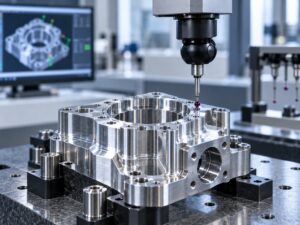
Why Look Beyond the Machining Process?
A machined component may still require finishing, coatings, inserts, assembly, packaging or documentation before it is ready for production.
Where several suppliers are involved, the customer may need to coordinate additional purchase orders, transport, quality requirements and delivery schedules.
For suitable requirements, bringing these activities together can reduce handovers and create clearer responsibility.
We can support precision CNC machining alongside finishing, secondary operations, insert installation, assembly, stockholding and scheduled call-off supply as part of a wider end-to-end manufacturing solution.
Not every project needs every service. The value lies in matching the manufacturing and supply route to what the component and production programme actually require.
Discuss Your Manufacturing Requirement
If your requirement extends beyond machining the component, talk to us about the complete manufacturing route.
Send us the drawing and explain what needs to happen before, during and after machining. We can review the requirement with you and identify where machining, inspection, finishing, assembly, stockholding or planned supply can be brought together more effectively.
The objective is not simply to quote the machining operation. It is to understand what you ultimately need supplied and agree the most appropriate route to deliver it.
Discuss Your Manufacturing Requirement.
Send us your drawing and production requirements to start the conversation.
Frequently Asked Questions
What is precision engineering?
Precision engineering is the controlled manufacture of components to defined technical requirements, with an emphasis on accuracy, repeatability and consistent quality.
Why is precision engineering important?
Precision engineering helps manufacturers control component variation, maintain consistent production and ensure parts continue to meet specified requirements.
Is precision engineering the same as CNC machining?
No. CNC machining is a core precision manufacturing process, but precision engineering can also include inspection, traceability, finishing, assembly and supply management.
How is quality controlled in precision engineering?
Quality can be controlled through process planning, controlled machining, in-process checks, final inspection and appropriate supporting documentation.
Why is material traceability important?
Material traceability provides a record of the material used to manufacture a component and can support quality assurance where traceability is required.
What does AS9100D mean for a manufacturing customer?
AS9100D is a quality management system standard developed for the aviation, space and defence industries. It builds on ISO 9001 with additional requirements relevant to aerospace and defence quality management and supply-chain control.
What should I look for in a precision engineering supplier?
Consider machining capability, engineering knowledge, quality control, traceability, secondary operations and the supplier’s ability to support repeat production and reliable supply.
